Saturday, August 29, 2009

waypoints

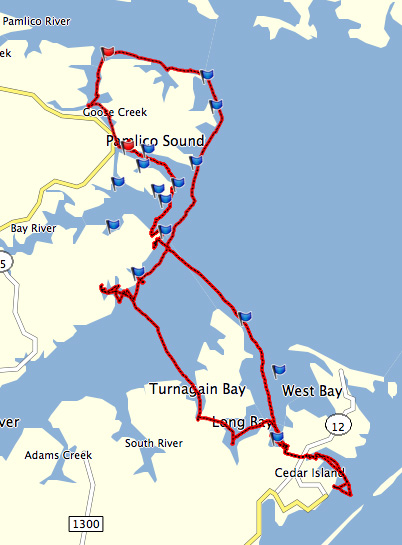
Just did this screen capture of our waypoints from Garmin's MapSource program (now that I look at it I see I need to go back and add Kent Narrows to the list). Bruce is shipping his gps to me, along with some other gear. I'll load these waypoints on to both his and my gps's. I'll also print out this screen shot and add it to the cruise cheat sheet, along with tide information, phone numbers, etc that I'll laminate and keep in the cockpit along with the Chesapeake Bay Chartbook from ADC. (Amazon has it on sale for $37.77 - a lot better than the $59.95 I paid a few years ago at the local bookstore.)

slight change of course

A small summer rain shower caught me as I headed to the ramp on the Eastern Branch of the Elizabeth River yesterday. Once I got the boat up in the parking lot I pointed it into the wind and raised the sails to dry them out. I cleaned up the boat and relaxed while the sails flapped in the breeze for about 45 minutes, I wanted them as dry as possible to avoid mildew. And while I was standing there I realized that in exactly a month we should be tied up at Ewell on Smith Island, the first stop of the trip. It is coming up fast.

We are still tweaking with the course for the Crab House 150. Or I should say I'm tweaking -- Bruce is hopping on a plane to Africa and will be out of the loop for a while.
One change is that we've decided to bypass Oxford and stop at Tilghman Island instead.
Tilghman Island, and particularly Knapp Narrows - the cut through the southern part of the island, seem more in line with the northbound part of the trip. Plus the logistics weren't working out well in Oxford. The marinas seemed expensive and the marinas, restaurant and hotel were more spread out than I liked. I have heard Oxford is a great place - we'll catch it on a later trip.
So they way it looks right now we'll be staying at The Tilghman Island Inn. Looks like a great place and reasonable too as rooms start at $120 and the marina is right there. Plus we've got a couple of choices for restaurants including The Bridge Restaurant and The Bay Hundred. Sounds like a beer at one and dinner at the other.
With just four weeks left I've got a lot of little jobs to do. Time to start making lists.

steve

Thursday, August 27, 2009

doodling atop the doodles


I had to dig out my old set of Pathfinder plans to get some numbers for my Mid-Atlantic Small Craft Festival registration form. I knew the length over all (l.o.a.) but had forgotten the other details like length waterline, beam and draft with the board up and down. So I pulled out the old plans for some numbers and had to email John Welsford to get the others.
It really touched my heart to look at those plans, I had not seen them for almost four years. But for the 20 months of building Spartina they were part of my every day life. They were wrinkled, written on and stained by blood, sweat and a few tears. Creased, torn and annotated in red pencil, they were the plans not just for the boat but for my life, at that time, too.
It reminded my of my favorite passage about a boat builder and his plans. The paragraph below is from a short story called Dead Reckoning in "Easy in the Islands" by Bob Shacochis.


"She'd ask, "How's it going?" He would look serious and say something like, "No turnbuckles. I can't find the right turnbuckles," or, "I'd like to know just how the hell anybody can afford teak?" Then he'd march off to one of the tables, unroll the big piece of graph paper he always had tucked under his arm, spread his order out on the diagrams and scratches, and study them while he ate, doodling atop the doodles he had made the day before. The plans were so coffee-stained and sticky I don't see how he got the boat built."

There is still a copy of that passage tacked up on the wall in my garage next to where I built the boat, right beside my charts of the Gulf of Mexico, Pamlico Sound, and Ocracoke, above and to the right of the bumper sticker that says "The floggings will continue until moral improves."

The entire process of building a boat, particularly for an unskilled amateur like me (no false modesty there - I'm lucky to drive a nail and can barely cut a straight line), is a pretty amazing affair. There is sort of an immersion I went through, like the guy in the short story who carried his plans everywhere he went, where it became part of my life (or maybe it was my life). And there were times where things were such a mess I could not see how I could get the boat built.

But I did get it built.

steve

Tuesday, August 25, 2009

On The Road Again

I see that Steve has the planning of our next trip well in hand. (He always does which is one of the reasons I love traveling with him.) I, on the other hand, am leaving on a trip next Tuesday and I wanted to do one last post before I go. I like the idea of hitting some of the great crab houses on our upcoming trip. (Thus the name of the blog, "The Crab House 150") But in all honesty, I wasn't all that keen on crab because of all the work involved getting to the meat. That is until I trapped Dungeness Crab in Alaska. Now I'm hooked!

These bad boys are large and one can fill you up, along with bread and salad and of course melted butter. One tried to escape so we ate him first, you know, to set an example for the others. I really love Alaska, it is such a beautiful place and there are so many outdoor things to do. It stays light forever during the summer so there is plenty of time to play. This photo was taken at midnight on July 3rd. Maybe a 15 second exposure. I was on a boat in a gorgeous anchorage so there was some boat movement. However, this is pretty close to what I saw.

Prior to that I traveled to New Mexico for the Eighth Annual High Plains Prairie Chicken Festival. The high plains of New Mexico are also an amazing part of our country. Flat and flatter. Narry a tree to break the flatness. (At least not native to the area.) The very early Spanish explorers sometimes got lost because there were no distinguishable landmarks for hundreds of miles. It all looked the same, mile after mile.

Except for an occasional windmill or oil pump this really is the wide open spaces. Perfect for Prairie Chickens to do their annual mating ritual. These birds gather at an open space called a booming ground and perform what's called leking behavior. The males arrive right at first light and start booming, cackling and stomping, whining and carrying on like I don't know what. Showing off for each other, staking out the best spots and looking cool for the ladies. That inflatable orange sack, called a tympanum, is what makes the booming sound. You have to hear it to believe it.

These are good looking birds and probably provided a great food source in earlier days. They can be very relaxed in the early morning. This one is a female strutting around getting the boys all excited.

This is a male, he doesn't seem too worked up yet with the days activities. These birds hit the same booming ground two times a day, at sunrise for a couple of hours and then again at sunset for a couple of hours. But these guys work pretty hard and when they think another male is on their turf the feathers really fly.

It's like kung foo fighting only with beaks and wings. As you watch, big tuffs of feathers are pulled loose from the combatants.

These three birds kept at each other for almost sixty minutes. In the meantime another male was able to woo the female. These guys were so busy with each other they missed out on the real action. The leking behavior can last for months. I bet the males need a long rest at the end of the season.I also like to tell people I went to Canada to shoot hummingbirds. I love the response I sometimes get, "they're awfully small aren't they, not much meat". I went to the Bull River Guest Ranch outside Cranbrook, BC for a hummingbird workshop. The guest ranch was terrific, great accommodations and five star cooking, meals were included. The workshop was put on by John and Barbara Gerlach of Gerlach Nature Photography. Great people, excellent photographers and a marvelous workshop. What could be better?

The hummingbirds were amazing. They come to the area to breed during the summer. There are hundreds of them. The above is a male Rufus and is about two or three inches in size. They are very aggressive and territorial. They have orange iridescent throat feathers .


Theses are Rufus females. They are smaller and have a touch of iridescence on their breast. They are very beautiful birds and fascinating to watch and photograph. It was a great week of photography and enjoying nature.

So with that I am off to Africa for three weeks and then returning to join Steve on the Crab House 150. I love Africa, too. This will be my third trip and I am looking forward to the great photo opportunities.

This photo was taken in the Masai Mara in Kenya. The Masai Mara is the northern part of the Serengeti eco system that continues into Tanzania. This trip will be to Botswana.

So, as I fade into the African sunset you can bet I will be keeping the Crab House 150 foremost in my thoughts.

Bruce

ebay on the bay??

Maryland crabbers gave economists a lesson in life according to a story in the Washington Post. The state decided there were too many licensed crabbers and too few crabs. They turned to economists to help solve the problem. The solution they came up with was a reverse auction. The state offered to buy back the licenses, a $50 face value, from the watermen at a price set by the watermen. Maybe a couple hundred bucks, maybe a few thousand. Sounds like a pretty good deal particularly when you consider that a lot of the license holders weren't even actively fishing.
The economists were looking for crabbers to set their "reservation price", the minimum that the sellers would accept. And that price was based on "game theory," the idea that each crabber would not know what the other crabbers were bidding so they would bid lower to beat out the other offers.
No deal said the waterman. They considered the licenses part of their heritage, a badge of their lifestyle. Less than a quarter of the eligible crabbers even submitted a price, and most of those prices were well beyond what the state wanted to pay. One unidentified fisherman offered to part with his license for $425 million. The state passed up on that deal.
Seems like the economists knew about supply and demand, reservation price and game theory. But the watermen taught them a little more, something about how hard is to put a price on a life on the water.

That's my friend Jimmy, a part time crabber that works the waters of Hampton Roads. I doubt he would give up his life working the crab pots at dawn.

Steve

Sunday, August 23, 2009

towns along the way


Just a little more than a month until the trip.  I took a few minutes to put together some information about the stops along the way.  This is an early draft, still have some more research to do.
Of course we'll have a couple of nights anchored out between Smith Island and Oxford, most likely off of Hooper Island and somewhere around Trippe Bay.  Then a couple of more nights anchored about off of Kent Island and Wye Island. 


Smith Island
Ewell Tide B and B
Smith Island
Ewell, Maryland, U.S.A.
Postal Zone 21824
410 425-2141
888-699-2141 
Wolfgang Max & Jelena Feiler 
-----------------------------------------------------------------------------------------------------------
Oxford
PIer Street Marina
Masthead At Pier Street Marina
106 W Pier St
Oxford, MD 21654-1345
(410) 226-517
Oxford Inn
504 South Morris Street
Oxford,  Maryland 21654
410.226.5220
Schooners
314 Tilghman St
Oxford, MD 21654-1319
(410) 226-0160‎
------------------------------------------------------------------------------------------------------
Rock Hall
Rock Hall Landing
5657 South Hawthorne Avenue, P.O. Box 448, Rock Hall, MD 21661
Tel: 410-639-2224/Fax: 410-639-2081
E-mail: dockmaster@rockhalllanding.com     
Mariners Motel
5681 South Hawthorne Avenue, Rock Hall, Maryland 21661
E-mail: reservations@marinermotelmd.com
Tel: 410-639-2291
Waterman's Crab House
21055 Sharp Street
Rock Hall, MD 21661
Phone: 410-639-2261
Fax: 410-639-2615 

hurricane bill

Hurricane Bill passed hundreds of miles offshore of the Outer Banks saturday bringing some big waves and not much else.  No damage to speak of, in fact a winter nor'easter causes more problems that what we got from Bill.  A local told me they get more damage from "No Name storms" (nor'easters) as they will hang off the coast for a couple of days.  Hurricane can come and go in a day or less.  
Below is a typically wave rolling in towards Rodanthe saturday afternoon.
Surfers were out looking for some great rides.  Saturday was a disappointment I think (I'm not a surfer) as the waves were not well-formed and the current along shore was treacherous making it difficult to get out to the clean water.  Waves were much better today with the "barrels" or "tubes" that make for great wave riding.  
For movie buffs, the house to the right in the photo below is "Serendipity", the house used in the Richard Gere film "Nights in Rodanthe."  I wasn't too much on the story line (was there one?) from the movie but I do think they did capture the feeling of the Outer Banks with the scenery, local color, wind and blowing sand.  Water surrounded the house for much of the storm - that stretch of the Hatteras coast, from the Rodanthe Pier north to Mirlo Beach, seems to take a beating from every hurricane and nor'easater.

steve


Wednesday, August 19, 2009

the tides are with us

I talked with a Smith Island Waterman the other day and he very nicely shared some information about the tidal flows through the Smith Island channels.  He told me two things.  One, than the tides running through the island are not that strong, about a knot or so.  Secondly, he said the tides would be in our favor.

We'll leave my home in Chesapeake early in the morning on the first day of our trip for a drive across the Chesapeake Bay Tunnel to Virginia's eastern shore (a $12.00 toll!!).  We'll make time for a quick breakfast at Stingray's (known to locals as "Chez Exxon") and then launch late morning out of Crisfield.  The tides for that day show a lot tide at 12:47 pm and then a flood tide coming in during the afternoon.  That means we'll be going with the incoming tides up the Big Thoroughfare to the village of Ewell.  Perfect.
The following morning we'll leave Ewell westbound toward the main part of Chesapeake Bay around 7 a.m., just at high tide.  There won't be much of any tide running, but if there is it will be on the ebb heading westbound to the bay.  Once again, perfect.

It is time to start looking at the details for the trip.  Just about five weeks until we launch.

Steve


ps  As I write this I am looking at the tropical weather map to the right.  Hurricane Bill is up to a category 4 storm.  It will pass off of the Outer Banks this weekend possibly sending swells from 12-15 feet on to the barrier islands.  It could be spectacular, it could be devastating.

Tuesday, August 18, 2009

man the lifeboats!!

Ever since Bruce read the safety requirements for the Yukon 1000 we have had an ongoing discussion about safety gear and how to use it on Spartina.  I think we have been well equipped on all of our trips but we try to learn and improve as we go along.
Bruce has been asking the question "What do we do if something goes wrong?"  I remember thinking a lot about that before my first solo sail on Spartina three years ago.   At that time I came across an article (can't remember where) that discussed "the small boat as a lifeboat theory".  In the event of a capsize, broken mast or injury the first step is to consider the boat you are in as a lifeboat.  Spartina as a lifeboat? Why not?  It has all the safety gear on board, positive flotation, hypothermia kits, first aid kits, satellite beacons, food and water.  The boat may be damaged or flooded but it will most likely float, so use it as a survival tool.  Bruce and I have always done this even if we never really talked it through.  Part of our SPOT 911 message states "we will remain with boat for as long as possible."
We always wear our inflatable life vests (a gift to the boat from Bruce) and in anything but the calmest weather we are tethered to the boat (when solo sailing I'm always tethered to the boat).  I've got a safety light clipped on my vest, Bruce is getting one to put on his.  And we each have whistles on the vests.
So Spartina as a lifeboat is Plan A.  So what is Plan B?  What if we have a problem that causes us to leave the boat?  Maybe a fire or the watertight portions of the hull are ruptured and the boat sinks.  In that case we grab and activate our SPOTS (we each have one), plus Bruce's epirb, the waterproof radio and the watertight duffels that we each have stowed up forward in the cockpit.  Those duffels will float, giving us something to hang on to, and increase our visibility from the air (mine is yellow and I think Bruce's is orange) .  Inside the duffels are extra clothes and complete Watertribe inspired hypothermia kits.   (A note on equipment color - My sleeping pad is bright green, my bivy is orange, my foul weather gear is yellow.  I want the bright colors around me to make it easier for search and rescue teams).
What if there isn't time to grab the duffels?  That will be Plan C, something new we will have ready to go on this trip.  Plan C includes two small watertight pouches that will have flashlights, signaling mirrors, fire starter tool and some first aid items.  Hopefully we would have time to grab the SPOTS, clip them and the survival pouches to our vests.  The pouches will be stored up under the coaming on the port side of the aft cockpit next to the throw rope (another safety item!).
This sounds more complicated than it really is.  We've got virtually all the gear already.  It is just a matter of having it organized and easily available.  And - most importantly - having a plan on how to use it. 

(For another safety item look at the photo above.  You can see a line around the stern cleat.  That is part of a boarding ladder than can be reached and deployed from outside of the boat).

I've spent a lot of time with the Coast Guard and I've been impressed with their training and planning, the step by step systematic approach to dealing with issues.  I think we'll take the same approach on Spartina.  Plan A - Spartina is a lifeboat.  Plan B - grab the duffels, SPOTs, epirb and radio.  Plan C - grab the SPOTs, radio and survival pouch.  Plan D - grab the SPOTs and inflate the life jackets.   

In the cruising that I have done, with Bruce or solo, I've never had a problem where I was concerned about my safety.  Once I was anchored when a weather front with funnel clouds passed over.  I thought their was a tiny, tiny chance of  being hit by a tornado.   I got out my duffel, clipped my SPOT and radio to it and kept it by my side as I read a nice book under the boom tent.  That is as close as I've been to using any safety gear.  But we do want (need) to be prepared.

If anybody out there has experience in this area, ideas or comments, we would appreciate hearing from you.

Steve

Sunday, August 16, 2009

Last Flag Down

Steve gave me a book about the voyage of the CSS Shenandoah, the last Confederate warship. The book is entitled "Last Flag Down" and was written by John Baldwin and Ron Powers. It is a good read, especially if you enjoy stuff about the Civil War and sailing. I was particularly interested in this book when Steve told me about it. I had read another book about another Confederate war ship, the CSS Alabama, one of the most successful "raider" warships ever. That book was entitled, " Wolf of the Deep", written by Stephen Fox.

The introductory part of "Last Flag Down" tells about one of the Shenandoah's co-captains, William Conway Whittle and his naval experience that led him to command Shenandoah. He was twenty years old when the Civil War broke out. Through a series of events he ended up (by default) as the Captain of the CSS Nashville, a 1220 ton, two masted side-wheel steamer designed to run passengers between Charleston and New York City. When the war broke out in 1861 the Nashville was fitted with canon and became the first combat ship of the Confederate Navy. Whittle was a third lieutenant at the time.

After a cruise to England, Nashville successfully ran the Union blockade near Beaufort, NC in order to return to port at Morehead City, NC. There the crew learned that the ship had been sold to a private group to be used as a blockade runner. Whittle's commanding officer and most of the crew left the Nashville for other assignments leaving Whittle and a skeleton crew the mission impossible task of running the Union blockade again in order to deliver the ship. Union sailors were pretty sore and embarrassed that the ship had broken through the first time and they were not going to let him get through a second time. Upon learning of Union General Burnside's advance on New Bern, NC, and with other Union forces closing in Whittle and his crew once again ran the blockade and escaped to successfully deliver the ship as ordered. Whittle would later be assigned to the Shenandoah.

I really enjoyed reading about some of the history of this part of North Carolina.This was a part of the state that Steve and I had cruised in the past, so we had some first hand knowledge of the area.


On our first cruise we left from Harkers Island and our last stop was Beaufort. We spent part of our day sailing around the area near Morehead City and in the area where the Union blockaded the entrance to the sound. On our last cruise we sailed up the Neuse River and ended up in New Bern. The fall of New Bern prompted Whittle to move his ship.

This is a painting by Herbert Eugene Valentine depicting Union forces breaking through the Confederate barricade on the Neuse River just below New Bern. New Bern is under attack in the background.

This is a picture looking back down the Neuse river from our hotel room in New Bern. Not a Union ship in sight. Steve and I spent several hours looking around New Bern. It has a great history. There are lot's of old houses and places of historical significance . Good food as well.

This is the James Bright House, circa 1790, and is the oldest house in New Bern.

While "Last Flag Down" isn't about North Carolina ports, the reference to areas where Steve and I have sailed the same waters, stayed in the same ports makes the history come alive and the adventure we shared all the more exciting and enjoyable.

Bruce

tropics gone wild!!!

I start watching the tropical weather pages in mid-August every year.  I like to see what is coming across the Atlantic, nice to be prepared both at home and for work.  It has been a quiet season up until now.  On Thursday there was a single storm out there.  Yesterday there was a storm, a tropical depression and an "invest" (a weather pattern worth watching for possible development).  And then today we have two tropical storms - Ana and Bill - a tropical depression and an invest.  Things are heating up.

The mid-Atlantic has had it easy to the last couple of years, it seems all the storms have gone to Florida or the gulf coast.  Checking the hurricane/tropical storm records for our area, they show just Cristobal in 2008 and Barry in 2007.  Ophelia paralleled Hatteras Island in 2005.  Three storms - Alex, Bonnie and Charlie (note the names, those were the first three named storms of the year) - caused a lot of flooding in the outer banks in 2004.  Isabel was our worst storm in recent memory, causing a lot of damage in 2003.
That is Buxton, the village near Cape Point on Hatteras hours before Isabel came ashore.  The storm surge rose up over the dunes and washed over the barrier island.  
And this is the north end of Hatteras Village the morning after the storm.  There had been a two story building attached to those steps.  It was picked up and moved a few hundred yards across the island.  Isabel caused a lot of damage to property, fortunately there were no fatalities in the outer banks from the storm (there were deaths caused directly and indirectly by the storm as Isabel moved inland).  

I'll be watching the storms as they develop.   I think the best spot to get information about tropical weather is the WeatherUnderground's tropical weather page.   Jeff Masters had a great blog there where he gives play by play for the storms.  I've added WeatherUnderground's gadget to this blog, you'll see it to the right.  That's a nice little tool and an easy way to track storms.

I've always heard that September 10 is considered the peak day of hurricane season - odds are there is a storm somewhere on that day.  Hopefully things will be quieting down by late September when we cast off from the dock in Crisfield, Md.

steve

Monday, August 10, 2009

caught on camera

A friend saw me sailing with my daughters Friday evening and she shot a couple of photos.  It was a nice sail and I'm glad to have a couple of photos of Spartina - I have wondered what she looked like from shore.  Thanks Cindy.
Heading down to Beaufort, North Carolina for a couple of days of work.  No sailing but I'll be out on the water and that will be fun.  Bruce and I sailed through there a couple of years ago, hope to be back there (with Spartina) next fall.

Steve

Saturday, August 8, 2009

heart of glass

Those are some members of the Portsmouth Boat Club out for their friday evening regatta on the Elizabeth River yesterday.  I've had the pleasure of sailing with some of their members in the past and always had a great time. 
I did something a little different from my usual weekend day sails on friday and saturday. I'm normally an early morning sailor, but this time I launched Spartina at the ramp friday afternoon, sailed a couple of hours, picked up my daughters on the waterfront and sailed with them for a while, dropped them off and then sailed until dusk.  
I sailed with the regatta for a while and was eventually left behind.  But after the race was over some of the fleet came back to tack back and forth across the river while enjoying a great summer evening and listening to a blues band playing in the waterfront park.  Great evening.
That's a Cape Dory Typhoon Senior, one of the boats in the race.  I've got a wooden boat and certainly do appreciate wooden boats.  But I'm also a fan of any nice boat and the Typhoon Senior is, to me, a classic.  As far as I'm concerned it doesn't matter what a boat is made from - wood, fiberglass, ferrocement, steel - a nice boat is a nice boat.  And there are a lot of classic fiberglass boats out there.  One of the books I've had on my reading list for years is Heart of Glass:  Fiberglass Boats and the Men Who Built Them.  It's about the post WWII designers who struggled to incorporate new technologies in to boatbuilding.  I've heard it is a great read.
Above is a nice Folkboat that was part of the regatta.  Early Folkboats were made of wood, but in the 70's fiberglass was being used in their construction.  Wood or fiberglass, a great looking boat either way.  
As the sun went down I tied up at the Waterside marina and left Spartina with her boom tent in place for the night.  I was back again this morning for a great day of sailing.  Excellent wind and a lot of fun. 

I did receive an email from the OBX130 guys.  They did their test sail in late July and uploaded some videos to youtube.  Check them out here, here and here.  I'm hoping to hear more about it soon.  I had hoped to make that trip in 2010 but my work schedule is not looking very good.  I may have to follow it on the web.  We'll see.

Steve