"When I think of all the fools I've been, it's a wonder that I've sailed this many miles." -Guy Clark

Thursday, February 12, 2009

future trips


I got an email from Bill Moffitt the other day about this summer's exploratory trip in advance of the 2010 OBX130.  I'm signed up to sail the 2010 event, but told Bill I could not make it for their test run this coming July.  Part of that is that I've got a family commitment, the other part is that late July strikes me as hot and buggy for a sailing trip (those guys are tougher than I am).  The 2010 event will be my first ever group sail.  I usually like to head out as a single boat.  As I told my wife and friends many times,  I built Spartina just so I could get the hell away for everyone else.  But I do like the sailing area for the OBX130 - Core Sound, Cape Lookout and Pamlico Sound - and Bill and his sons sound like great guys.  It will be interesting to travel in a group, kind of cool to see other boats on the water.
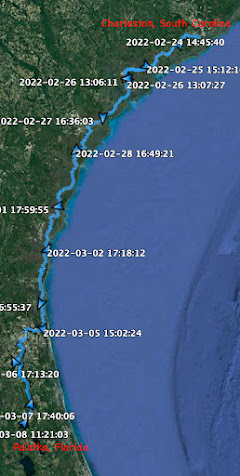
There are some other trips that interest me.  My favorite is the Everglades Challenge.  That 2009 event is just three weeks away.  These guys are very serious.  Here is how their website describes the event: The Everglades Challenge is an unsupported, expedition style adventure race for kayaks, canoes, and small boats.  The distance is roughly 300 nautical miles depending on your course selection.  There is a time limit of 8 days or less.  Your safety and well being are completely up to you.  Unsupported means that there are no safety boats or support crews to help you during the race.  You are not allowed to have a support crew follow you or meet you during the race.  It is OK to have family or friends meet you at the official checkpoints, but they cannot provide anything other than emotional support.
I don't think I'll ever compete in the event.  A Pathfinder isn't the right design for this event, plus I would rather take my time, read a book, take a nap or cast out a lure.  But I do enjoy following the event on the web.  The last couple of years I have followed via the web a couple of kayakers from my neighboring state of North Carolina - Kiwibird and Sandybottom.    Although they are kayakers and I am a sailor, I learn quite a bit from the way they train, the equipment they use and their mental approach to journeys on the water.  Someday I hope to sail that stretch of the Florida coast from Tampa to Key Largo, but I don't think it will be in a race.
Another trip, one that I hope I can attend someday, is the Texas 200 run by Chuck of Duckworks.  I love that stretch of the Texas coast, in fact my first ever cruise - this one aboard the original Spartina, a Sam Devlin designed Nancy's China - was along that stretch of water.  I'll get down there someday.

In the meantime I'll look forward to the OBX130.  The photos above show my jeep and Spartina at the marina in Engelhard and then Spartina a few hours later double reefed and heeled over in a good breeze.  Maybe someday that jeep will tow Spartina to Texas or Florida.  We'll see.

Wednesday, February 11, 2009

short stories

I love to read.  I love to read when I'm out on a cruise.  I love to read short stories.  Here are some books of short stories that I have enjoyed.

Cruising Paradise by Sam Shepard   

No, not a sailing book at all.  It's about solitude and loss, growing up in the southwest, Mexico and show business.


Wonderful short stories by the movie director John Sayles, the recurring theme is care and concern for others. 

Jesus Out to Sea: Stories by James Lee Burke

I've been a big-time fan of Burke for years.  Stories from the gulf coast about coming of age, failure and faith.

Easy in the Islands by Bob Shacochis

Ok, this one has to do with water.  Stories about paradise, lost or otherwise.  Tales of the Caribbean and even the mid-Atlantic.   When I read "Dead Reckoning" I had never heard of Ocean View or Old Dominion.  Now I live near those places.

Now I need to find a book or two for this trip.  Any suggestions?

on the water

Out on my home sailing waters for the first time this year, but not on Spartina.  I was the guest of a waterman on his Chesapeake Bay deadrise.  Sunny and warm, it was a beautiful day.  The old workboat, built out of douglas fir in the early 1960's, showed her character with peeling paint and worn decks.  A jumble of wires, some leading nowhere, ran here and there.  Bits of line, spare anchors, worn out gloves were scattered about.  An open flame from a gas burner warmed the small cabin.  


The waterman cruised across the James River and talked about his decades on the river.  Crabbing, scallops, tugboats -- he has done it all.  In a couple of days he will be eighty years old.  He said he'll stay off the water tomorrow, gale-force winds are predicted.  But the following day, his birthday, he'll be out again.  "Work on your birthday and it means you'll work the whole year."  (I wish I could get a guarantee like that in this economy.)  He had a new side scan sonar on board, part of a state project.  The river's bottom appeared on the small screen plain as day.  Old crab pots, pipe lines, artificial reefs, even pieces of rope were easily seen.  But after a lifetime on the river the waterman said the screen didn't show him anything he didn't already know.  
As we headed back in to the harbor he talked on the radio with his friends out on the water.  The general opinion was that we are in for more cold weather, but the days are getting longer and the turn in the seasons is not too far off.

That's a satellite photo of my home waters.  Known as Hampton Roads, it is the confluence of the James River (coming in from the top left) and Elizabeth River (coming up from the bottom of the frame).  
I use a boat ramp down at the lower right near the bridge marked 460.  The city of Norfolk is on the right, across the river is Portsmouth.  Out on the river, just off of Portsmouth's Crawford Bay and the old Naval Hospital (built in 1823), is Mile Marker "0" of the intracoastal waterway.  Crawford Bay is an anchorage for cruisers from around the world.  Early on weekend mornings during sailing season that will be me in the gaff-rigged yawl slipping in and out between those well-travelled boats.  I'll be out there soon.  As the watermen said, the turn in seasons is not too far off.

Monday, February 9, 2009

Weather (or not)


Blue skies or stormy weather, it is hard to tell what to expect out on the water.  The top photo was taken after a front had rolled through the afternoon before.  Cool, clear wind came out of the northwest.  I flew across Pamlico Sound east bound past Great Island and then Bluff Point, swung northwest on my way to Wysocking Bay.  Fantastic day.  
The photo below IS the front rolling through the day before.  I had been anchored in a creek off of Mouse Harbor doing a little fishing and reading when I decided to check the weather radio.  The clear skies didn't seem to match the alarms and alerts pouring out of the radio.  Broad bands of thunderstorms were sweeping across eastern North Carolina.  About an hour later they showed up in my area.  Local weather reports from Swan Quarter, New Bern and Jacksonville had reports of winds 40 to 50 miles per hour, quarter-sized hail and funnel clouds.  I moved out to the center of the creek where I could swing 360 degrees on anchor, raised the cb and rudder and put up the boom tent.  For the next four hours Spartina, with mizzen still raised, swung back and forth like a weather vane as the storms cells flew by to the north and southwest.  It was an interesting evening.    My two concerns were lightning and tornadoes.  Fortunately I did not have to deal with either.  Otherwise I was just fine, had a nice dinner and enjoyed a good book.  (It was a sobering reminded to routinely check the weather radio - I'm not sure what would have happened had I been out there sailing when that weather hit.)
I plan my Spring trips between early May and mid June, after the severe Spring weather has rolled through but before the Summer heat arrives.  Below is the Hatteras area wind compass for May from Windfinder. com.  You'll see winds mostly out of the southwest, but sometimes of the northeast as the summer weather pattern has not completely taken over.  Either wind direction is fine by me.  Average temperatures are about 70 degrees.  We should have good weather for a late May/early June trip.  But we'll be prepared for whatever comes our way.

Sunday, February 8, 2009

Packing


This is a sketch I did for gear and supplies for my first cruise on Spartina.  It was a four day trip on Tangier Sound.  Chuck at Duckworks published some photos from the trip.
My handwriting is not the best, so it might be difficult to read my notes.  Up under the foredeck I had my boom tent, sleeping bag, porta-potti, anchor and some veggies up in a mesh hammock.  Water, in one gallon bottles, is under the bunk flat, easily accessible through two eight in diameter ports.  Clothes and food were stored in the thwart.  Batteries, fishing gear, first aid gear, flaries and cleaning supplies were under the cockpit seats.  Outboard spare parts and tools with at the aft end of the cockpit.  As you can see there is plenty of room to tuck away the gear.  This layout was for a single-handed cruise.  There is still plenty of space for two people.  When Bruce and I did out Carolina trip in the fall of '07 we had room to spare.   That's                     one of many things I like about the Pathfinder -- lots and lots of storage space .


Picked up a few items at the grocery store.  Spaghetti, tomato/mushroom sauce in a pouch, asian noodles with kung pao sauce in a pouch, cous cous in a box (that I'll put in a bag for the trip) and a few other items.  Now that we've got a better map for the trip I need to plan out potential anchorages, stops at marinas and stops at hotels.

Saturday, February 7, 2009

boat work


Nice warm sunny day.  Perfect for getting a little work done on the masts.  I brought the masts, both main and mizzen, out of the the front porch.  Facing west, the porch turns in to a nice little "oven" in the afternoon, just what I needed for some winter time epoxy work.  I sanded down the mahogany chafe pad on the main where the gaff jaws meet the mast under full sail.  
I had noticed during the first couple of season that the jaws wore a groove in to the douglas fir mast.  Last winter I added the mahogany chafe pad to take some of the wear and tear.  
The jaws still bit in to the the pad, so today I sanded it smooth and added a clear coat of epoxy.  Next time it warms up I re-sand and add a few coats of varnish.  That will get me through this year.

As I said, the masts are made of douglas fir.  The guys at Yukon Lumber had a good laugh when I dropped by and asked for sitka spruce.  "If we could find it, you couldn't afford it."   Their suggestion was douglas fir, an idea seconded by all the folks on the jwbuilders site.  

My Dad and I spent four days building the two masts.  For the main we used a 2x8x20, the mizzen came from a 1x8x16.  We used the bird's mouth style of construction.  It was surprisingly easy.  One day to rip the boards and cut the "V" notch, one day to glue, one day to plane down the peaks (got to love the electric planer!) and one day to sand the masts in to their round shape.  

We finished the masts early on a hot summer afternoon.  Afterwards we sat out on the shady deck, talked about boats and woodworking and sipped Corona's with a slice of lime.  I don't think I'll ever forget that afternoon.
Sadly Dad couldn't stick around to sail the Pathfinder.  He passed away that winter.  Look at the bottom of the mast.   You see the round imprint from a Liberty Quarter from his birth year that is epoxied in to the mast step.  There is another Liberty Quarter under the mizzen mast for my Mom.
The pennant that flies at the top of the main is a gift from Mom.  I designed it using the Pathfinder sail plan as a logo.  It was hand sewn by the Sailbag Lady.  The JW stands for John Welsford, but it has another meaning for me.  My Mom's name is Janice, my Dad's name is Walter.  They are always along with me when I sail.

126??


Why Skeeter Beater 126?  The Skeeter Beater comes from the use of my Outdoors Research Bivy Sac, sort of a one-man tent with no-see-um netting that keeps the moquitoes at bay.  I was going to put a link to a website for the bivy sac here, but now that I look I see they have changed the types (and cost) of bivy sacs that they offer.  I'll have to do a little more research on that.  I got mine a year ago from Amazon.com.    I'll need to check on that as I know my sailing partner will want (need) one.
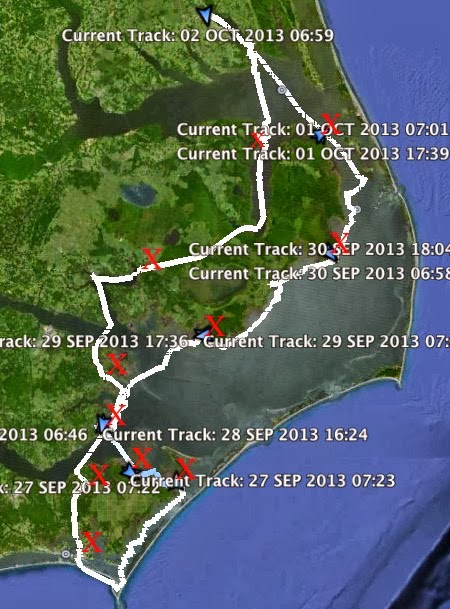
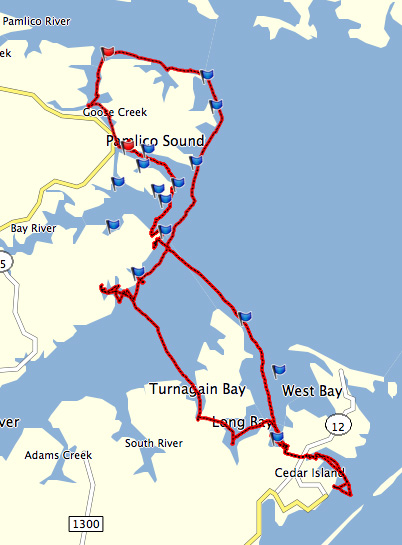
The 126 comes from some of some early winter planning on the trip.  I was looking at two different options.  One involved circling Pamilico Sound counter clockwise from Engelhard to Swan Quarter, Oriental, Cedar Island, Ocracoke and then back to Engelhard.  The other option was Engelhard to Pamlico Point, Oriental and ending at New Bern (and renting a car to retrieve my jeep and trailer from Engelhard).  Both of those trips measured about 126 miles.  Bruce liked the second option best, he pointed out that it offered more places to visit, creeks and bays for anchorage and more protection in case of bad weather.   We have since added Bath and Vandemere to the trip, bringing the path to about 155 miles.  We have ten or eleven days for the sail, so that should work out just fine.  We can always add or subtract stops depending on winds, weather.
One place that we will not miss is Oriental, the great little sailing town on the Neuse River.  We spent an afternoon and night there during our '07 trip, meeting some great folks and enjoying a couple of cold ones on the waterfront.

Wednesday, February 4, 2009

odds and ends


That's the bow wave as Spartina crossed Pamlico Sound south of Swan Quarter last fall.  I always like the way the Pathfinder hull cuts through the water on a nice reach.  That narrow forefoot slices through the waves and pushes the water up and away from the hull.  You can also see the mahogany trim I've added to the the douglas fir rub rails.  The rub rails were pretty beat up after two seasons, particularly mid-ships.  So I added a layer of mahogany - both uppper and lower,  and, on top of that, about a four foot length of brass half oval.  So now the brass strips take the brunt of the wear and tear as I tie up alongside the docks.
I saw on Duckworks Magazine a piece by Perry Burton about building his Pathfinder.  He lives up in Newfoundland, Canada.  Wow!  Serious weather and sailing up there.  But I think he has picked the right design for small boat sailing in those waters.  For lumber he is, with permit in hand, cutting down trees and towing them across water to a waiting truck and then sawing them in to shape.  Not only is the weather serious up there, but the boatbuilders are too!  He wants to be sailing by next summer.  I'll look forward to following his build, but even more I want to see how the Pathfinder handles the ocean up there.

Cold with snow flurries here, so not much work with the boat.  I did find my paint at Jamestown Distributors, steel gray for touching up the cockpit.  Twelve bucks less than West Marine, but ten bucks of shipping.  I come out a little bit ahead, but not much.  I did buy a four pack of lithium AA batteries for the Spot satellite tracker (I wrote a piece about this nice little device for Chuck at Duckworks - I'll note here if he publishes it).  Most importantly this week I bought, cooked and ate a package of Simply Asia spicy kung pao noodles with sauce and peanut topping.  It was an excellent meal and will definitely make the provisions list for the boat.  Total prep time, including heating up the water, was less than 15 minutes.  Good meal, plenty for two people.  Add a little chicken from a foil packet and we'll be dining in fine style.

Monday, February 2, 2009

About the boat...


Spartina is a Pathfinder open cockpit yawl designed by John Welsford of New Zealand.  I first read about his boats when I came across David Perillo's tale of a ten-month cruise in a Welsford-designed Navigator.  That got my attention!
The Navigator is obviously a great boat, but my eye was drawn to the slightly larger Pathfinder.  She is 17' 4" length on deck with a beam of 6' 5".  The yawl rig carries about 162 square feet of sail between the gaff-rigged main, mizzen and jib.
I'm not a boat builder or even a woodworker.  But I really wanted a boat that I could use for cruising so I decided to give it a go.  Advice was easily found both from John himself - he's very accessible over the internet - and the jw builders discussion group.  It turned out to be a learn as you go project from my experience.  The initial work is pretty basic - cutting frames from 3/8 plywood.  Then add stiffeners, brackets, supports.  Next, scarf the bottom panel out of two sheets of 1/2" plywood.  Mount the frames, then add stringers (that's the stage you see in the photo above).  Doing the first batch of planks is a little tricky, but each plank after that gets easier.  
I built my boat in about 20 months (but I confess I went a little crazy doing it, working five evenings during the week and six or seven hours each day on weekend).  As I said I'm not a woodworker so the boat is a lot like me - rough around the edges.  More of a work boat finish than a yacht finish.  But what is important to me is that she is both solid and  true to John's design.  
The name Spartina comes from both the cordgrass that lines salt marshes and one of my all time favorite books, Spartina by John Casey.  The novel, a 1989 National Book Award winner , is about a fisherman and boat builder that lives in the backwater salt marshes of Rhode Island.  He is struggling to build his boat, realizing at the same time that the world has become too small for people like himself.  A great read.
I think the name Spartina is appropriate as the Pathfinder, with cb and rudder raised, can sail in very shallow water.  Some of my best memories of cruises are skirting the edges those Spartina marshes under just mizzen and jib, ghosting along and enjoying the beauty of nature.

Sunday, February 1, 2009


 Good time to get started on my jobs.  I did track down the problem with the trailer tail light.  A wire connector inside the frame had corroded and the wire broke off.  Easy fix there.  I'll get a screw cap connector, shoot it full of silicone sealer and tightened it down on the wires.  The silicone will harden and minimize salt water getting the wires.  While I'm at it I'll replace as many connectors as possible the same way, that should save me some time down the road.
Also took apart the center board winch and lubricated it.  John Welsford's plans called for a wooden cb with some lead in the lower end.  I substituted a 1/2 inch thick steel plate (with John's approval).  I liked the idea of having all that weight - it comes in at about 100 pounds -down low.  It adds to the stability of the boat, but it is heavy to lift.  So I mounted a winch on the thwart right next to the starboard side of the cb trunk.  Twice I year I take the winch apart to lubricate the springs and levers inside the housing - just takes a few minutes.

I've got to straighten up Spartina's cockpit.  It is not too bad, probably about an hour's work to 
sort  through everything and get it tucked away.  My last sail was in mid-November, a nice day trip down to Croatan Sound behind Roanoke Island.  Since then I've just tossed things in to the cockpit.  I'll take care of that one morning this week.
I sent a check for $31 in to Virginia's Department of Game and Inland Fisheries.  They handle boat registrations and the $31 will cover me for the next three years.  It is hard to believe that it has been almost three years since I initially registered and launched Spartina.    I've had a lot of fun, cruised some interesting waters and met some great people in the last three years.