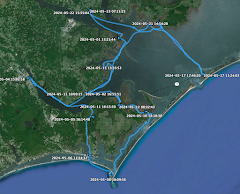
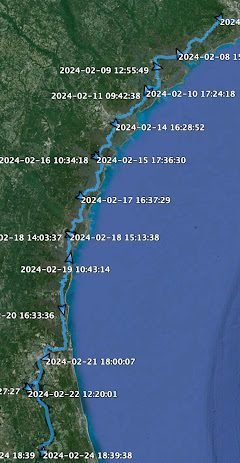
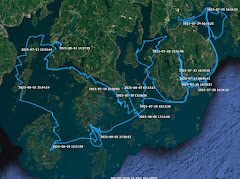
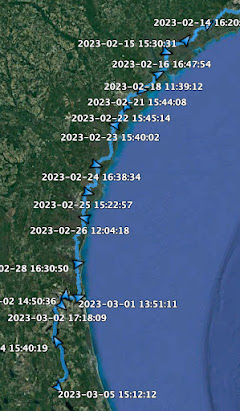
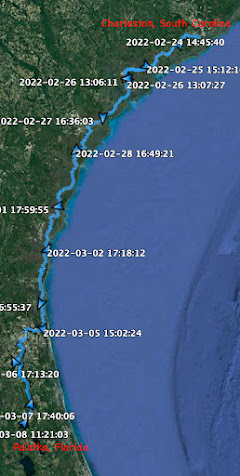
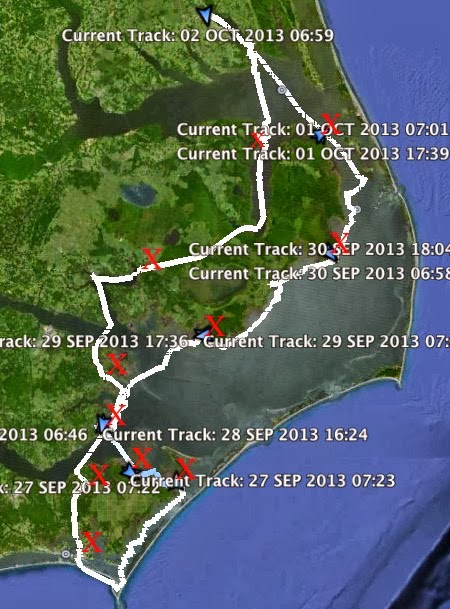
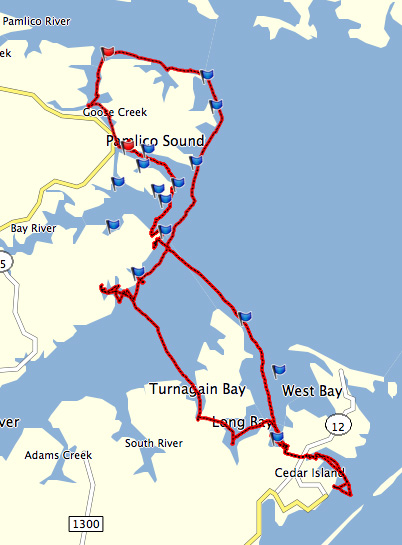
Spent the day washing and drying out the gear, scrubbing down the boat and sorting things out. Also downloaded tracks from each of our gps's. And then talked about future plans. That's a map of Chesapeake Bay. The calendar is opened to October.


Steve
 Below the dog Jack gets involved as Bruce tries out his Bivy.
 Beautiful weather today with clear skies, comfortable temperatures and a nice breeze. From what I see that weather should hold for a few days.
 We'll be ready to deal with whatever comes our way. I've got a fishing guide friend who told me a few years ago "If you wait until everything is perfect to go fishing then you will never go."
 Bruce shot the photo of me rigging sails down at Harkers Island. I had the sailmaker, E. S. Bohndell Co., put it two sets of reef points in the main. That was money well spent. I can sail under full sail, single reefed main, double reefed main, jib and mizzen only or main only. That is a lot of options to deal with the variety of wind.
 I don't understand weather as well as I would like, but I suspect the difference might be the front that a few days ago was forecast to be sitting right over Pamlico Sound this weekend. Now they show it holding up north over Chesapeake Bay, then sliding farther to the north over the next couple of days.
  This is at the north end of Core Sound, clear skies to the north and a squall moving up from the south. Sunshine and rain. We'll see a little bit of it all.
 Also took a look at the seven day front forecast. Accuracy this far out is far from certain, but I'll be watching this page as we get closer to see what we can expect. It really doesn't matter a lot. Being out there from seven to ten days means we will see at least one full cycle of weather - warm moist air from the south being pushed out by a (relatively) cooler mass of dry air from the northwest, the mixing of the two possibly bringing some rain and thunderstorms. And then a couple of nice days while the humidity builds again. We've got the gear to deal with all that and will take it as it comes.
 The last time we sailed together we drove down Hwy. 17 to Harkers Island on a rainy day. We left Chesapeake in a light mist, about sixty miles down in to North Carolina is was a heavy downpour.
 I had never expected to use the bilge pump with the boat high and dry on a trailer but there I was in a gas station parking lot somewhere north of New Bern pumping out the boat. Got some strange looks from the truck drivers. (This was a lesson learning event on the trip, the first of several. Since the boat wasn't going to be in the water that day I had not snugged down the waterproof ports, particularly those under the seats in the aft cockpit. The heavy rains put a couple of inches of water in the boat, some of which got in to the storage areas. Always snug down the hatches and to bag the gear, even if kept in a waterproof (supposedly) area.)
 That next day we sailed out of Harkers Island Fishing Center in the rain, thunder rumbling in the distance. By midafternoon is was blue skies.
  I've done a little maintenance on the trailer. Added axle grease to the spring loaded reservoir on the hubs. I try and do that a couple of times a year using the waterproof axle grease. Also getting new tires for the trailer. It came with "B" tires. I'm upgrading to "C" which can handle more weight. I'll use one of the "B" tires as a spare.
 Above is one of my favorite ways to explore possible anchorages, with the main furled and sailing under jib (which you can see) and mizzen (which you can't see). I'll stand in the aft part of the cockpit and sail along the marsh - in this case Mt. Pleasant Bay - just nudging the tiller with my knee as I follow the curve of the shore. That grass along the shore is spartina alterniflora. My Spartina is just right for sailing here.
 Above is evening on Mt. Pleasant Bay with my department store anchor light. Very peaceful place where I saw a school of tailing puppy drum swim by the boat. A tiny beach on the shore was shared by snowy egrets and ibis (both the white and glossy). Black skimmers ghosted over the smooth surface with their lower bills just touching the water. Beautiful spot. Our anchorage the first night of the Skeeter Beater should be somewhere close to here.
 Below is my current anchoring system (with the shackles cut open). I use a 10 lb. navy style anchor, five feet of chain and an 8 or 10 lb (it is not marked and I can't remember which) mushroom anchor as a sentinel clipped by a carabiner to the top of the anchor chain. This is an idea I read about in the late, great magazine Small Boat Journal back in the 80's. The idea is that the added weight at the top of the anchor chain makes the anchor itself more effective as the flukes are held in a more vertical position and dig deeper in to the bottom. I typically anchor in mud and/or sand and this system has never failed me. I use less chain which makes it easier to handle as I deploy and recover it. Great for single-handed sailing.
 I encountered the highest winds at Mouse Harbor. It was a line of thunderstorms that swept across eastern North Carolina over a four hour period. I can't say what the winds were at my anchorage, but the line of storms had winds over 50 mph, hail and a couple of funnel clouds. I moved out to the center of a small cove so the boat could swing 360 degrees, raised the cb and rudder, left the mizzen raised to act as a wind vane and point me in to the wind, and set the boom tent in place. I spent the evening reading comfortably at anchor. ( Next to me I had my watertight hypothermia kit, Spot beacon, strobe/flashlight and vhf radio all tied together - just in case.)
 Basically I keep my personal gear on the starboard side of the boat and Bruce will keep his on the port side. The rest of the gear, food, supplies is spread about the boat, neatly tucked away. Here is a rundown.....
 Above is a photograph Bruce shot of me fixing dinner on Core Sound. Meals, particularly after a long day on the water, can be a highlight of the day. For dinner I had always used a combination of boiling bag rice (cooked in the pot on the right side of the stove) and onions, peppers and fish (salmon or tuna in a foil packet) grilled on a griddle. Bruce, when he joined me in the fall of '07, saw some room for improvement. He hasn't done much sailing, but he has done a lot of camping and has experience with camp meals. He'll be taking charge in that area.
 All spring I've been tossing an extra item of two into the grocery cart for the trip. This past weekend I did a little census to see what we've got. Here's the count (this is for a trip that will probably take, depending on wind and whimsy, 7 to 10 days).
 The other fresh food we hope to have available is fish caught along the marshes. Those are filets from a nice speckled trout that I caught on Caffee Bay near Swan Quarter. Grilled with onions and peppers and served on top of the rice with juice from a fresh lime, it was a great meal. I have fished off of beaches and power boats for years, but I'm still learning how to fish off of a sailboat. It takes a little practice to get the boat in the right spot, and it takes some experience to recognize the right spot. Speckled trout and puppy drum (called redfish on the gulf coast) will be the fish we are after.
 I've sorted through my fishing kit to get ready for the trip. I don't take too much gear, maybe a couple of dozen soft lures that are slid on to hooks with 1/8 oz. lead heads. I'm trying out the Storm lure on the left for the first time this trip. It is a larger soft lure (as opposed to the hard bodied mirrorlures and such) with two treble hooks. If you look close you can see that I have pinched down on the barbs on the hooks. With a fish flopping on the line I want to avoid getting myself snagged. Last time I did that it took a doctor and two nurses to get the hook out of my hand.
 And there is the anchor light below on a breezy evening at Great Fox Island on Tangier Sound. I used to clip it to the lazy jacks at night when I slept every night under a boom tent. On nights now without a forecast of rain we'll sleep in the bivy sacs and not use the boom tent. So I've moved the anchor light forward to the bow stay where it doesn't interfere with the view of the night skies that we'll get looking up through the bivy's bug screen.
 Back up to the top photo you can see Bruce's gps sitting on top of the chart book. One of our first jobs when he gets back here will be to import my waypoints in to his gps. We've both got Garmin gps's and I think they use the same MapSource software, so that should be easy. We'll spend some time on the computer the first night he is in town working on waypoints, buying our NC salt water fishing licenses and also updating our Spot profiles online. The next day will be food shopping, junk on the bunk (Bruce's army term for laying all our gear out on the floor and marking it off on a check list) and then packing the boat and jeep. We should be headed south by sunrise the next morning!
 These tall, wide mouth storage jars are a good example. I carry six of them on Spartina. They stand vertically in the storage area underneath the thwart, three on each side of the centerboard trunk. A lot of the food goes in there, I marked the contents on top of the lids so I can open the watertight port and quickly locate what I need. You see fruit cups on the left, breakfast bars on the right. These jars cost $1.00 each at the Dollar Store. While building the boat I had sketched out a list of supplies and made note of Nalgene storage jars. But those jars - colorful and made of high impact materials - run $17.00 EACH. These $1.00 jars do the job I need.
 I always have a Rite in the Rain all weather notebook nearby when I'm sailing. I use it to jot down quick notes throughout the day that will be the source for my log book in the evening. If you can make out my handwriting (the nuns would cringe at how the Palmer Method failed me) I was approaching the inelegantly named Clump Island and Great Fox Island on Tangier Sound, trying to locate the channel that separated the two. I find these books here and there, sometimes at hardware stores, sometimes in little shops. They do cost a couple of more bucks than a regular pocket note book, but the writing and pages hold up very well even when soaked by rain or salt spray.
 My anchor light came from WalMart for less than $10. It is a simple LED lamp that uses three AA batteries. It is not designed to be waterproof, but this lamp had been out in heavy rains with 30 mph winds and keeps on glowing. I keep two on board, one to hang up in the rigging, typically on the forestay, at night. The other I use as a reading lamp. I've looked at other waterproof, multiple LED lights at camping stores but can't see a reason to spend $25 for them.
 I made my tethers based on a description in a John Welsford sailing story. I think it is 1 inch diameter polypropolene line with a carabiner at one end and a quick release clip (that came from a boat shop) at the other end. The line is easy to find because of the bright color and it floats too. I did some eye splices on each end. My splicing skills are not as good as Bruce's so I wrapped read electrical tape around the splices to clean it up a little. Bruce and I each have a tether of the same design and clip them on to some very nice, safe self-inflating pfd's with built in harness that Bruce was kind enough to donate to the boat. We'll skimp on a lot of gear, but we won't skimp on safety gear.
 I made my boarding ladder out of an old piece of nylon line using a design from Hervey Garrett Smith's The Marlinspike Sailor. I leave it hooked on the deck cleat on the starboard quarter with the ladder itself inside the boat tucked behind the forward end of the boomkin. It sits there out of the way ready for a swim or an emergency. From outside the boat, and I've tried this out, I can reach up and pull the ladder over the side for use in boarding. I've used it a couple of times while swimming. I have never used it in case of a knockdown or man over board, but I'm glad to know it is there.
 I was thinking about Tangier Island today as I had to go over to the Eastern Shore of Virginia (hey, I get paid to do this sometimes!). I was surprised by the amount of development along Highway 13, the main route up the shore. Shopping centers and hotels. Even a new bridge under construction out to Chincoteague Island. I got to wondering about Tangier Island. I haven't been there since the cruise I mentioned in yesterday's post. While making the 100 mile drive I remembered that I had been there earlier and took some photographs on the island, thought I might post them here. I wonder how it has changed since then. Is the old skiff still there in the marsh, or has it been carried away by the tides?
 Crabbing is the main industry and crab pot markers decorate a sandwich shop at the ferry dock. You'll see the markers spread out all over Tangier Sound, the hum of diesels of deadrise crab boats is a constant during daylight hours. Fog surrounded me early on the second day of my Tangier Sound cruise. It was only by following a line of crab pots (this was in my pre-gps days) that I could find a course from Great Fox Island to Watts Island.
 This is the beach on the southwest shore of the island. Beautiful white sand looking out on Chesapeake Bay. The fence in the dune is to help minimize the erosion. But with an island that is just a foot or two above sea level erosion is hard to stop.
 The main gut (I would have called it a channel or a creek, locals call it a gut) runs through the island as lights glow on the homes on the west ridge. The road on the west side of the island has homes, a couple of bed and breakfasts (well worth a weekend vist ) and the small air strip.
 And this is part of the marsh at Port Isobel, a small island just east of Tangier. The buildings in the distance are part of the Chesapeake Bay Foundation's center.